
Free · No sign-up
Published 13 Sep 2026
Creatine comes in several chemical forms. One of them has decades of research behind it. The others are mostly attempts to solve problems the first one does not really have.
Healthy adults who train. If you have kidney or liver problems, are pregnant or breastfeeding, take prescription medication, or are under eighteen, this is a question for a doctor or a pharmacist rather than for a page. Creatine is not a neutral substance for everyone, and none of what follows is written with those situations in mind.
Three groups cover almost everything on the shelf.
| Form | What it is | Why it exists |
|---|---|---|
| Monohydrate | creatine bound to a molecule of water | the cheapest form, and the one nearly the entire research literature is built on |
| Hydrochloride (HCl) | creatine bound to hydrochloric acid | dissolves far more readily in water, which is its main practical difference and the basis of most claims for it |
| Buffered forms, esters, chelates | other salts and compounds | marketed on absorption or stomach comfort; the pattern below applies to them too |
Monohydrate raises muscle creatine stores and improves performance in high-intensity, repeated-effort work. That is one of the better supported findings in the whole field, resting on a large number of trials over a long period.
For the newer forms the position is narrower. None has been shown to do more than monohydrate at what creatine is taken for. Where they have been compared directly, the results have not favoured the newer form; more often they have simply not been compared in enough trials to say anything with confidence.
That is not the same as saying they do not work. It is saying that the case for them rests on solubility and marketing rather than on outcomes, and that the burden of proof sits with the more expensive option.
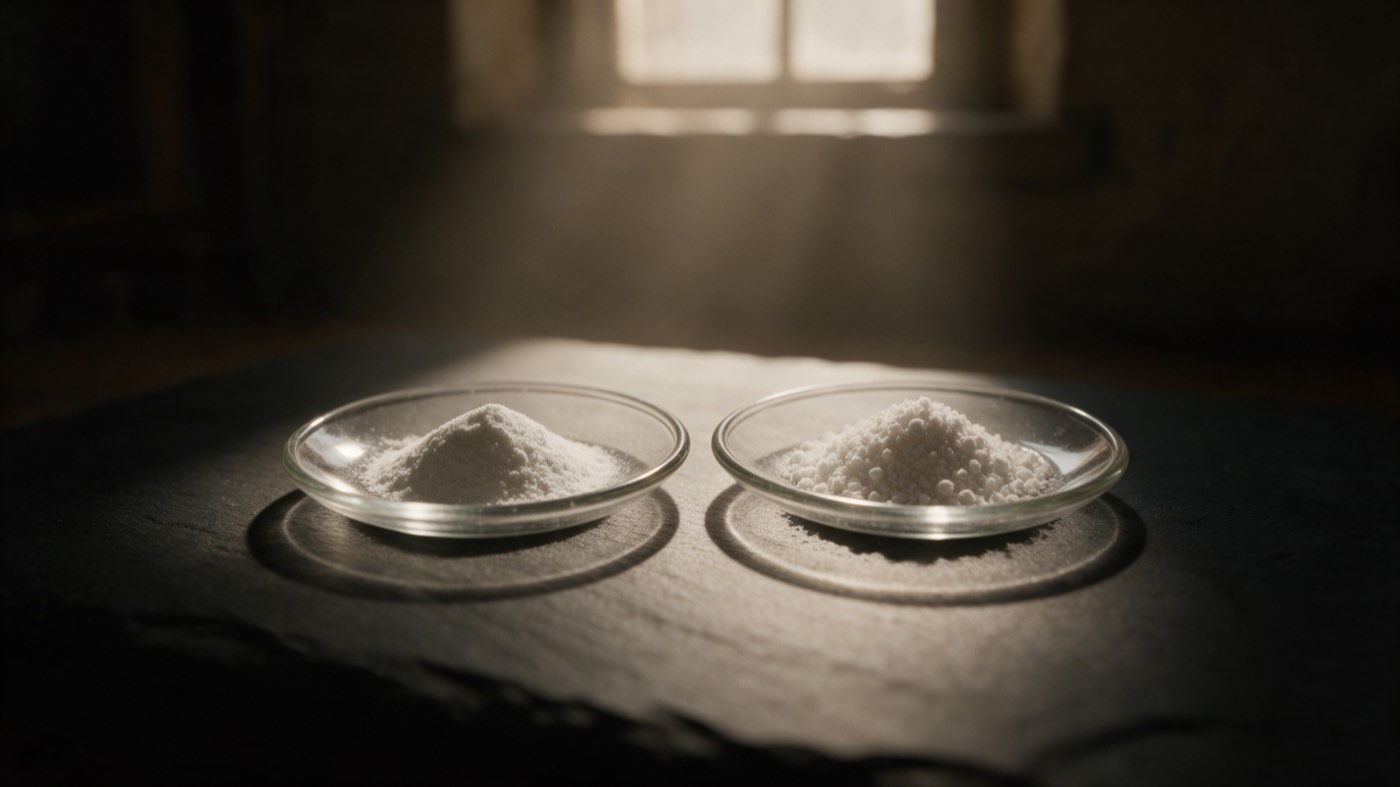
HCl does dissolve better, and that is a difference you can see in a glass. The argument built on top of it is that better solubility means better absorption, less stomach upset and a smaller effective dose.
Absorption is the weakest link in that chain: monohydrate is already absorbed well, so there is little room to improve on it. Stomach comfort is more reasonable. People who get discomfort from monohydrate sometimes do better with a more soluble form, and for them that is a real reason to switch. Dissolving monohydrate in more water, or taking it with food, often solves the same problem for nothing.
Monohydrate is one of the cheapest supplements with good evidence behind it. The newer forms cost several times as much per serving. That gap is what you weigh against the advantages above, and the advantages above are comfort and convenience rather than effect.
The position most of the evidence supports: start with monohydrate, because it is what was studied and what costs least. If it does not sit well with you after trying it dissolved in more liquid and taken with food, a more soluble form is a reasonable thing to try, for that reason and not because it promises more.
Name products. Which brands are well made is a question about manufacturing and testing rather than chemistry, it changes over time, and this site does not sell supplements or take a position on who makes them. What is written above is about the forms, not about the labels they arrive in.
Not in what it does, on the evidence available. It dissolves better, which can help if monohydrate upsets your stomach, but no form has been shown to outperform monohydrate at raising muscle creatine or improving performance.
Because it is the form nearly all the research used, and because it is the cheapest. Both are good reasons, and neither is a claim that the others are useless.
For most people, no. The advantages are comfort and convenience rather than effect. If monohydrate reliably upsets your stomach even taken with food and plenty of water, that is a reasonable case for paying more.
Micronised monohydrate is simply ground finer so it mixes more easily. It is the same compound, a convenience rather than an upgrade.
This page does not name products. Brand quality is a manufacturing question rather than a chemistry one, and this site neither sells supplements nor takes a position on who makes them.
More reading: loading phases · when to take it · all posts
There is no creatine setting in the app, nothing to log, and nothing being sold here. This page exists because it is a question people who lift keep asking, and because a straight answer is harder to find than it should be: what is known, and where it stops. That is the same thing the app does with the numbers it does own: your training and your food, worked out from your own data, with the rule shown.